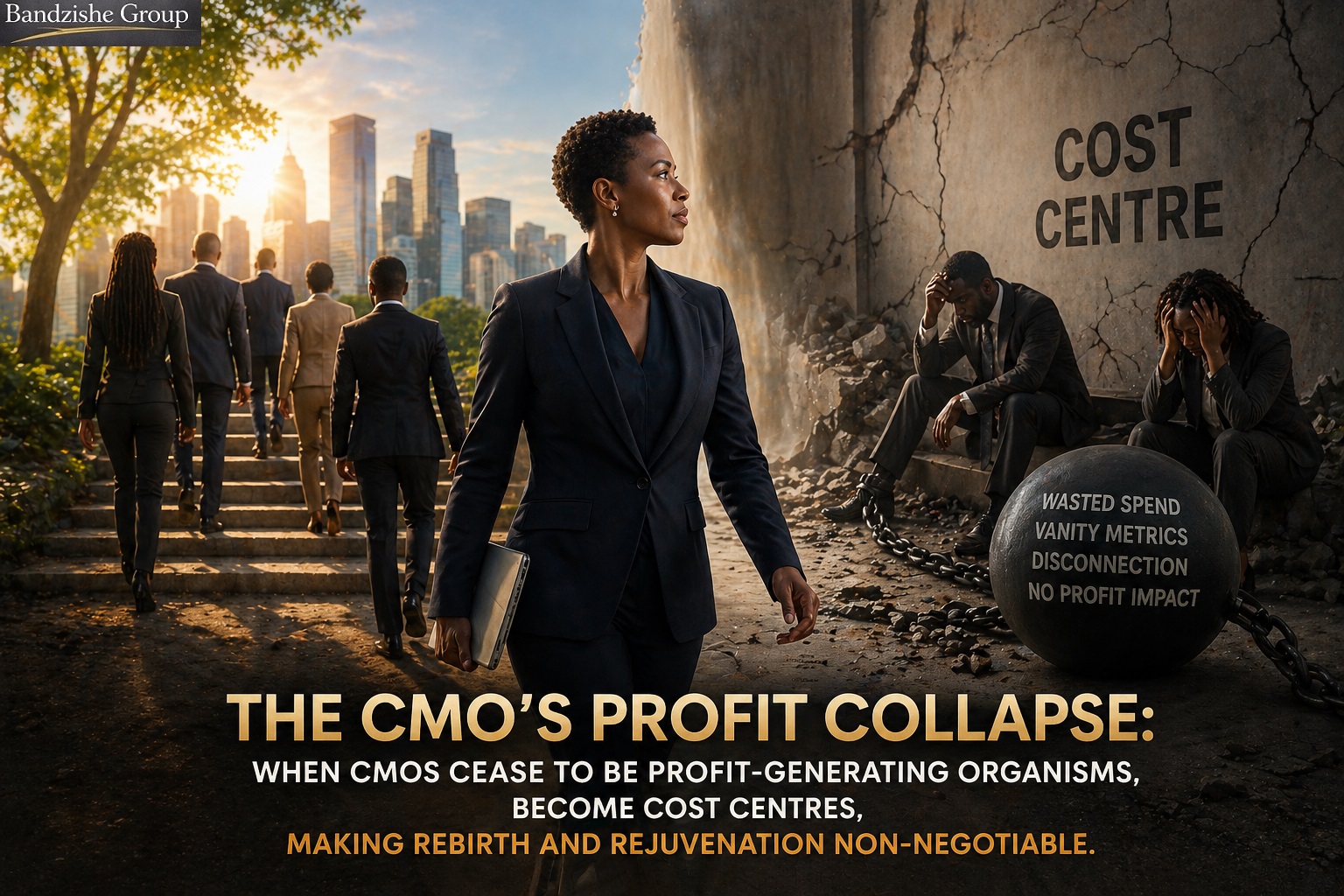
CMOs are profit-generating organisms. That is their mandate. The most destructive force in contemporary enterprise is not macroeconomic recession, geopolitical fracture, or the accelerating pace of technological disruption; it is the quiet, systematic degradation of marketing leadership into an administrative expenditure to be contained rather than a commercial force to be unleashed. Across Fortune 500 boardrooms, FTSE 100 executive committees, Johannesburg Stock Exchange-listed conglomerates, and fast-growth technology ventures on every continent, a structural reckoning is underway, and it is arriving with the cold precision of a financial audit. The Chief Marketing Officer, once positioned as the primary generator of market share, competitive differentiation, and brand-led revenue expansion, has, in far too many enterprises, suffered a catastrophic demotion: from profit-generating organism to cost centre, from strategic sovereign to budget supplicant, from commercial peer of the chief executive to a functionary who must apologise for expenditure that cannot be immediately reconciled to a quarterly revenue line. This is not a peripheral career inconvenience affecting a small class of executives in a single industry; it is a structural crisis within the architecture of the modern enterprise, one whose consequences accumulate silently, with compounding ferocity, until they manifest as competitive erosion, margin collapse, and market share surrender.
The question that every board of directors, every chief executive, and every Chief Marketing Officer must now confront without the comfort of delay or the luxury of institutional incrementalism is this: when marketing leadership ceases to create measurable commercial value, who bears the cost of that failure? The answer is unequivocal, and it is the same in Johannesburg as it is in New York, London, Singapore, and Frankfurt. Everyone does.
That cost is simultaneously immediate and generational, devastating in the near term and existentially corrosive across the institutional long run. In the short term, a marketing function reduced to cost management cannot generate the demand, the brand loyalty, or the pricing power that sustains competitive advantage in markets where consumer attention is scarce and competitor investment is relentless. In the medium term, it loses the internal political authority to secure the budget, the data access, the cross-functional collaboration, and the board-level sponsorship that elite marketing performance genuinely requires to deliver commercial results of institutional consequence. In the long term, it accelerates the professional obsolescence of the CMO role itself, as boards and chief executives, frustrated by the persistent absence of demonstrable commercial return, seek alternative organisational arrangements that bypass the function entirely, reassigning strategic market authority to chief revenue officers, chief growth officers, or artificially intelligent demand-generation systems that ask no questions about creative direction and produce no requests for brand campaign investment. This precise trajectory has already played out in documented, highly visible fashion at organisations of global prominence, and the South African corporate landscape is not, by any stretch of analytical credibility, immune from its logic.
The signal is clear, analytically irrefutable, and commercially alarming: marketing leadership that cannot speak the language of commercial return will be demoted, restructured, or eliminated. The rebirth and rejuvenation of the CMO as a genuine profit-generating force is therefore not a strategic preference to be contemplated at leisure; it is the only available path to organisational survival and professional authority.
The Anatomy of the Collapse: How Strategic Vision Became Budget Dependency
The declension of the Chief Marketing Officer from commercial sovereign to fiscal dependent did not occur suddenly, with the dramatic rupture of a single institutional crisis; it occurred with the slow, inexorable momentum of a structural failure that organisations mistake, at their peril, for the natural evolution of a maturing function. For decades, marketing operated under an implicit, institutionally convenient agreement with the boardroom: the function would build brand equity, cultivate consumer awareness, and create the intangible conditions for revenue growth, and the organisation would fund these activities on the reasonable faith that commercial outcomes, even when they could not be precisely attributed, were the downstream consequence of upstream marketing investment. This agreement was sustainable, and indeed rational, when brand equity could not be measured with sufficient precision to invite hostile scrutiny, when attribution technology did not exist to connect marketing inputs to commercial outputs with causal clarity, and when the cost of marketing under-performance remained obscured within large, undifferentiated budgets whose internal efficiency was beyond the reach of real-time analytical inspection. The digital revolution shattered that agreement with forensic and irreversible finality. Suddenly, every click, every conversion, every impression, every consumer interaction, and every brand-influenced purchase decision generated a data trail that boards of directors, chief financial officers, and activist shareholders could scrutinise with unprecedented granularity, historical depth, and comparative rigour, and many CMOs, accustomed to the protective ambiguity of pre-digital marketing, were found institutionally wanting in ways that were neither subjective nor forgiving.
The measurement revolution did not merely expose inefficiency within individual campaigns or marketing programmes; it exposed an intellectual and commercial positioning failure at the very heart of marketing leadership, a failure to evolve the function's self-definition from one grounded in creative distinction and audience reach to one grounded in financial rigour, causal attribution, and board-level commercial language. What was revealed was not incompetence in the conventional sense, but a strategic miscalibration whose consequences were, by the time they became visible, already institutional and structural rather than personal and correctable. The result was both predictable and painful: marketing became, in the institutional imagination of too many enterprises across too many geographies, a cost to be managed rather than an investment to be amplified, and the CMO's seat at the revenue table became, correspondingly, a position to be justified rather than a role to be exercised.
The evidence of this miscalibration is neither speculative nor recent; it is documented, visible, and drawn from the deliberate decisions of organisations with the scale, analytical capability, and institutional authority to make corporate verdicts that resonate across industries. In 2017, Procter and Gamble, the world's pre-eminent consumer goods enterprise and a company whose marketing investments have historically defined industry practice, conducted a rigorous experiment that should function as a permanent strategic reference for every CMO and every board: it reduced its digital advertising expenditure by approximately two hundred million dollars and observed, with considerable institutional candour, that sales performance remained substantially unchanged across the affected categories. The implications were seismic, not because the reduction itself was remarkable in the context of Procter and Gamble's overall commercial scale, but because it demonstrated that years of marketing spend had been generating digital impressions without generating commensurate commercial momentum, and that the organisation's marketing leadership had not detected this divergence with sufficient urgency or analytical rigour to prevent it from reaching the scale of a two-hundred-million-dollar inefficiency. In the same year, Coca-Cola eliminated the role of Chief Marketing Officer entirely, replacing it with a Chief Growth Officer whose mandate explicitly subordinated the creative sovereignty of brand stewardship to the commercial primacy of revenue generation, profit margin expansion, and shareholder value creation.
Two years later, Unilever followed with equal deliberateness, abolishing the CMO title in favour of a Chief Growth and Marketing Officer designation whose primary institutional metric was, without ambiguity, commercial impact rather than brand awareness or marketing creative quality. These were not isolated corporate eccentricities reflecting the idiosyncratic preferences of individual chief executives; they were institutional verdicts, delivered at the scale of global organisations with combined revenues exceeding one hundred billion dollars, upon a marketing leadership model that had allowed itself to become commercially indefensible in the language that boards, investors, and capital markets actually use. Each of these decisions sent a signal, with the authority of institutional precedent, to every board, every chief executive, and every Chief Marketing Officer globally: the function must earn its seat at the revenue table, or it will be removed from it. The South African corporate world observed these developments with, in too many documented instances, insufficient urgency, allowing the same structural vulnerabilities to calcify within its own marketing functions without the corrective intervention that global precedent should have prompted.
The Cost-Centre Trap: The Structural Logic of Institutional Marginalisation
The designation of marketing as a cost centre is not a neutral financial classification; it is a political sentence whose execution is gradual, systemic, and, once institutionalised, remarkably resistant to reversal. Within the institutional grammar of the modern enterprise, cost centres are managed for efficiency whilst profit centres are managed for expansion, and this binary distinction determines, with near-mathematical precision, the organisational authority, budget leverage, strategic influence, and board-level credibility available to each function at every point in the economic cycle. A marketing function coded, explicitly or implicitly, as a cost centre will always face budget compression during economic headwinds, always find itself subordinated to the immediate revenue imperatives of the sales function, and always discover that its investment in long-cycle brand equity is the first sacrifice placed upon the altar of quarterly earnings management.
The logic of this trap is self-reinforcing in its cruelty: as marketing budgets contract, the function's capacity to generate measurable commercial impact diminishes; as commercial impact diminishes, the institutional justification for larger future budgets weakens correspondingly; as budgets weaken further, the CMO's authority erodes, their tenure shortens, their team loses capability through attrition, and the entire deterioration accelerates with a velocity that quickly outstrips any individual executive's capacity to arrest it. What makes this trap particularly insidious, and particularly consequential for the organisations ensnared within it, is that it can be entered from a position of relative historical success; a function that has performed strongly for years may fall into the cost-centre classification through the gradual failure to build and maintain the measurement infrastructure and board-level commercial narrative that are necessary to defend marketing's value when institutional pressures mount and patience for ambiguity expires. The CMO who cannot produce, in real time, with the analytical fluency of a chief financial officer and the strategic clarity of a chief executive, a defensible quantification of marketing's contribution to revenue growth, customer lifetime value, market share protection, and shareholder return is, regardless of their personal brilliance, creative vision, or functional commitment, operating without institutional armour in an environment that has become forensically hostile to ambiguity.
The Gartner CMO Spend Survey of 2024 delivered a data point that should have functioned as a strategic alarm, loud and unignorable, for every marketing leader and every chief executive who oversees one. Average marketing budgets across the surveyed population of organisations had declined to 7.7 per cent of company revenue, a significant and structurally meaningful reduction from the 9.1 per cent recorded in the preceding year, representing a compression of approximately 1.4 percentage points that, across a large organisation, translates into tens or hundreds of millions of dollars of reduced marketing investment capability. For those who wished to interpret that compression as a temporary corrective, as a one-cycle response to macroeconomic headwinds rather than a permanent institutional verdict on marketing's perceived commercial value, the Gartner CMO Spend Survey of 2025 has removed the comfort of that interpretation with forensic and irreversible finality. Budgets remained flat at 7.7 per cent in 2025; neither recovering towards the 9.1 per cent of 2023 nor collapsing further, but settling at precisely the level that signals not a temporary blip but a permanent transition, a calculated stagnation that has replaced the spontaneous generosity of high-growth spending cycles with the disciplined austerity of an institutional capital allocation framework that no longer regards marketing investment as an article of unquestioned strategic faith. This is not the temporary pressure of a difficult trading year; it is the structural recalibration of the modern enterprise's relationship with its marketing function, and it will not reverse through the passage of time alone.
The decline was not driven solely by macroeconomic austerity or the general tightening of corporate discretionary expenditure; it reflected a deeper, more structurally important institutional scepticism about marketing's demonstrable commercial return, a scepticism that has now been building for years across the CFO community and has reached the boardroom with sufficient momentum to reshape permanently the budget conversations of organisations across industries and geographies. Where chief financial officers and chief executives perceived a clear, causally defensible link between marketing investment and revenue outcome, budgets were defended, and in some cases expanded, with institutional vigour. Where that link was ambiguous, anecdotal, contested, or simply absent, marketing expenditure was reclassified from investment to discretionary cost, and reduced with the quiet efficiency of a function whose institutional advocates lacked the evidentiary confidence to mount a compelling defence.
The structural lesson requires no embellishment: the CMO who does not command the measurement systems, the attribution models, the revenue waterfall analytics, and the financial vocabulary to establish and sustain that causal link between marketing investment and commercial outcome is, irrespective of their strategic sophistication or their creative reputation, institutionally defenceless. The catastrophic irony that should disturb every marketing leader's sleep is this: the very moment a marketing function most needs increased investment to reverse declining brand strength, arrest competitive share erosion, or capture an emerging market opportunity, it is least likely to receive it, precisely because it has failed to build the evidentiary case, over time and with disciplined persistence, that would compel a rational board to increase its commitment.
The Tenure Crisis: When Leadership Brevity Becomes Organisational Fragility
No single metric expresses the structural precarity of the Chief Marketing Officer's institutional position more acutely than tenure, and no single metric is more consequential in its implications for the commercial performance of the organisations within which that tenure is exercised. Across the C-suite, the CMO holds the unenviable distinction of being among the most transiently occupied executive positions in the contemporary enterprise, with average tenures at major corporations that are consistently and significantly shorter than those of chief executives, chief financial officers, chief operating officers, and, increasingly, chief technology officers. This brevity of occupancy is not merely a career inconvenience for the individuals affected; it is a structural liability of institutional consequence, with direct and measurable effects on the commercial performance of marketing functions whose most significant contributions, particularly those related to brand equity construction, customer lifetime value optimisation, and long-cycle demand generation, require strategic time horizons that fundamentally exceed the average CMO tenure cycle. A CMO who departs after three years, whether through resignation, restructuring, or the board's loss of patience with commercially indefensible ambiguity, leaves behind not merely an incomplete strategy but a disrupted team, an eroded institutional memory, an abandoned measurement infrastructure, and an organisation that must absorb the substantial transaction costs of leadership transition precisely when marketing continuity is most commercially valuable and least negotiable.
The tenure problem is simultaneously a symptom and an amplifying cause of marketing's institutional marginalisation: CMOs are displaced because they cannot demonstrate sufficient commercial value rapidly enough to satisfy boards operating under relentless quarterly earnings pressure, and their displacement prevents the sustained, long-cycle strategic work that would, over time, generate the commercial value that justifies their continued occupancy. This is a vicious cycle of institutional logic, not a natural selection mechanism producing stronger marketing leadership; it demands structural remediation at the level of how organisations govern marketing, measure its contribution, and align its time horizons with the board's expectations, rather than the personal resilience of individual CMOs who are being judged by standards that the governance of their function makes it structurally impossible to meet.
The tenure crisis carries a South African dimension that compounds global pressures with intensely local structural realities, producing an environment of accelerated institutional pressure that marketing leaders in more stable economies may not fully appreciate without the benefit of direct experience. South African chief executives and boards, operating under the dual and compounding pressure of structurally constrained economic growth and heightened shareholder scrutiny from both domestic and international institutional investors, exhibit a demonstrably lower tolerance for marketing leadership that cannot demonstrate near-term commercial relevance in financial metrics that a CFO would recognise as rigorous. The post-pandemic environment in South Africa, characterised by elevated input costs driven by rand depreciation and global commodity price inflation, load-shedding-induced operational disruption that has cost the economy hundreds of billions of rands in foregone output, subdued consumer confidence suppressed by high unemployment and rising household debt service costs, and a regulatory environment that has added compliance complexity to an already demanding operational context, has accelerated the pressure on every executive function to justify its existence in explicitly financial terms that admit of no ambiguity. Marketing leaders who entered this environment equipped with brand-building philosophies and creative leadership frameworks, but lacking the commercial measurement discipline to quantify their contributions in the language of finance and governance, found themselves exposed in ways that their counterparts in more economically stable contexts, operating with larger budgets and more patient institutional shareholders, might have survived.
The consequence, across several of South Africa's most prominent listed and private organisations, has been either the premature departure of genuinely capable marketing leaders who lacked the commercial vocabulary to defend their institutional position, or the progressive narrowing of the CMO mandate to tactical execution and marketing operations management, with broader strategic authority migrating to the chief executive, the chief commercial officer, or the chief revenue officer. The result is a hollowing-out of marketing's institutional intelligence at precisely the moment when the South African economy, navigating structural reform, competitive pressure from international entrants, and the profound digital transformation of consumer behaviour across income segments, most requires the market-creating, consumer-insight-led, brand-building intelligence that only institutionally empowered marketing leadership can provide.
The Budget Compression Reality: Marketing Investment in a World of Constrained Capital
The relationship between marketing investment and enterprise value creation is one of the most rigorously studied and most consistently misunderstood dynamics in the commercial literature of the past three decades, and its systematic misrepresentation within the boardrooms of organisations that have reclassified marketing as a cost centre carries consequences that cannot be corrected by the passage of time alone. Decades of academic research, including the foundational long-run effectiveness studies published through the IPA Effectiveness Databank in the United Kingdom, the empirical work of the Ehrenberg-Bass Institute at the University of South Australia on brand growth and mental availability, and the canonical effectiveness research of Peter Field and Les Binet on the relationship between brand-building investment and commercial performance, have established with an evidentiary weight that defies casual dismissal that sustained, strategically coherent marketing investment generates compounding commercial returns across brand equity appreciation, customer acquisition efficiency improvement, pricing power enhancement, and long-term revenue trajectory strengthening.
The cruellest irony of the current institutional moment is that precisely as this evidence base has become most robust, most analytically rigorous, and most directly applicable to the governance questions that boards and CFOs actually ask, the institutional appetite for sustained marketing investment has most significantly eroded, driven by a structural bias in corporate capital allocation that privileges near-term earnings performance over long-cycle competitive capacity. The post-pandemic fiscal environment, characterised globally by elevated interest rates, compressed operating margins across most industries, intensified shareholder pressure for quarterly earnings delivery, and a geopolitical uncertainty premium that has increased the institutional discount rate applied to long-cycle investments of all categories, has created a structural preference against any investment whose most commercially significant returns manifest over a time horizon longer than twelve to eighteen months. Since the most consequential effects of sustained brand-building investment, particularly those related to mental availability growth, sustainable price premium, customer loyalty deepening, and the competitive moat that brand strength provides against new market entrants, accumulate over years and decades rather than quarters, marketing has found itself positioned on the wrong side of an institutional time preference that systematically undervalues its most strategically important contributions whilst over-rewarding the short-cycle, tactically driven performance marketing activity whose returns are visible quickly but which erodes long-term brand equity with the quiet persistence of structural decay.
The South African macroeconomic environment has amplified these global pressures with a severity that reflects the specific structural characteristics of an economy navigating profound internal challenges whilst simultaneously competing for international capital in an increasingly demanding global investment environment. South Africa's real GDP growth has remained structurally constrained across the post-pandemic period, suppressed by the compounding effects of Eskom's operational instability and the associated cost of load-shedding on business productivity, infrastructure degradation across road, rail, and port logistics that has increased the cost of doing business for exporters and manufacturers alike, a skills emigration dynamic that has reduced the availability of specialised human capital in precisely those knowledge-intensive sectors where premium commercial capabilities are most required, and a policy uncertainty environment that has suppressed private sector fixed investment and prolonged the period of economic under-performance relative to South Africa's potential output. In this environment, corporate marketing budgets have faced pressures that exceed the normal discretionary austerity of a global economic downturn; they reflect a structural reallocation of corporate capital towards operational resilience infrastructure, energy self-sufficiency through diesel generators and solar installations, regulatory and compliance expenditure, and working capital management, leaving marketing budgets in direct competition with survival expenditures rather than merely competing against other growth investments for a fixed pool of corporate capital.
South African CMOs who have not built an internally compelling, financially rigorous, and evidentially robust case for marketing's commercial return have found their budgets among the first casualties of each successive round of corporate cost rationalisation, not because their boards are hostile to brand-building, but because, in the absence of persuasive commercial evidence, marketing expenditure is indistinguishable from any other discretionary cost that can be reduced without immediate, visible, and attributable commercial consequence. The most commercially astute South African marketing leaders have understood that the budget conversation must be fundamentally reframed: from a negotiation about expenditure allocation to a demonstration of causal commercial impact, from a discussion about marketing's creative ambition to a presentation of marketing's financial return, and from a request for institutional tolerance to a delivery of institutional proof.
The South African Dimension: Structural Constraints and the Imperative of Commercial Precision
South Africa's commercial landscape presents the global CMO crisis in concentrated, high-stakes, and analytically instructive form, offering a microcosm of the institutional pressures that the global marketing leadership community faces, amplified by the specific structural characteristics of an emerging market economy navigating profound internal reform whilst competing for capital, talent, and consumer confidence in an increasingly demanding global context. The Johannesburg Stock Exchange, home to some of the African continent's most sophisticated and internationally integrated corporations, has produced a class of marketing leadership that operates simultaneously within global strategic frameworks calibrated to international best practice and intensely local economic constraints that global frameworks rarely accommodate adequately, a dual tension that creates both distinctive organisational capability and distinctive institutional vulnerability.
The most commercially agile South African CMOs have understood, through the discipline of hard operational experience, that effective marketing leadership in an environment characterised by the widest income inequality of any major economy, significant linguistic and cultural diversity across twelve official languages, digital adoption at profoundly uneven speeds across income segments and geographies, a consumer base whose purchasing behaviour is shaped by forces ranging from load-shedding schedules to taxi commute patterns, and a financial services landscape where a significant proportion of the population remains meaningfully under-served, requires a degree of contextual sophistication, cultural intelligence, and segmentation precision that global playbooks calibrated for homogeneous developed-market consumer populations simply do not provide. Yet the structural pressures on marketing budgets remain severe, and the institutional patience for marketing investment that cannot be immediately reconciled to commercial return is shorter in South Africa than in most comparable economies, partly as a consequence of the heightened uncertainty premium that institutional investors apply to South African corporate earnings and partly as a consequence of the particular short-termism that constrained economic conditions tend to produce within executive teams under earnings pressure.
The single most consequential strategic failure of South African marketing leadership across the past decade has not been the absence of creative talent, the lack of strategic ambition, or the insufficiency of technical marketing capability; it has been the widespread failure to build and maintain the commercial measurement infrastructure that would allow marketing's genuine contributions to be expressed in the financial language that boards, investors, and chief executives actually use to make capital allocation decisions. South African marketing organisations that operate without a functioning, board-reportable marketing attribution system, without a quantified model of marketing's contribution to customer acquisition and retention economics, and without a commercially rigorous framework for connecting brand equity investment to pricing power and competitive resilience, are operating with a structural institutional deficit that no amount of creative brilliance or strategic vision can compensate for in an environment where every rand of corporate capital is subject to forensic scrutiny.
The most dangerous CMO in the contemporary South African enterprise is not the one who lacks strategic capability; it is the one who possesses genuine strategic capability but cannot translate it into the financial language that commands boardroom respect and secures institutional investment.
South Africa does not suffer a shortage of marketing talent; it suffers, in too many of its most important organisations, from a shortage of marketing talent that has been equipped with, or has developed for itself, the commercial measurement frameworks, the CFO-grade financial literacy, and the board-level commercial narrative capability that transform individual marketing excellence into institutionally defensible enterprise value creation.
The Rebirth Mandate: From Marketing Expenditure to Commercial Revenue Authority
The rebirth of the Chief Marketing Officer as a genuine profit-generating executive requires nothing less than the complete reconstruction of the function's commercial identity, its institutional positioning, its measurement architecture, its internal governance structures, and its relationship with the enterprise's financial oversight mechanisms. This is not a cosmetic intervention, achievable through the cosmetic adoption of revenue-oriented language in board presentations or the superficial deployment of marketing technology platforms that generate impressive dashboards without genuinely connecting marketing activity to commercial outcome; it is a structural reconstruction that demands the intellectual honesty to acknowledge where the function has failed, the institutional courage to challenge the organisational conventions that have perpetuated that failure across multiple leadership cycles, and the technical rigour to build the attribution frameworks, customer lifetime value models, revenue waterfall analyses, and brand equity monetisation methodologies that allow marketing's commercial contribution to be expressed, in real time, in the financial language that boards and investors actually use to assess enterprise performance and allocate capital.
The rebirth is simultaneously an intellectual journey of considerable personal demand and a commercial engineering project of considerable organisational complexity, and both dimensions must be pursued with equal commitment if the transformation is to achieve the institutional depth that genuine commercial repositioning requires. The CMO who approaches this transformation as a communications challenge, seeking to persuade a sceptical board through the rhetorical eloquence of their presentations rather than the evidentiary rigour of their commercial proof, will find the transformation superficial, transient, and ultimately unsuccessful. The CMO who approaches it as a structural challenge, requiring the redesign of the function's measurement systems, talent architecture, governance frameworks, and institutional relationships, will find the transformation durable, self-reinforcing, and commercially significant.
The practical mechanics of this rebirth are specific, sequenced, and non-negotiable in their importance, regardless of the industry, geography, or organisational scale within which the CMO operates.
The first imperative is the construction of a closed-loop marketing attribution system that connects every significant marketing investment, whether deployed through brand advertising, performance marketing, content strategy, experiential activations, events, or digital engagement, to specific, commercially measurable outcomes, expressed at a granularity sufficient to satisfy CFO-level scrutiny and withstand challenge from a board whose members include financially sophisticated non-executive directors.
The second imperative is the development of a marketing-contributed revenue model that quantifies, with analytical discipline and statistical integrity, the specific proportion of company revenue that is causally attributable to marketing's activities across the three principal commercial dimensions of customer acquisition, customer retention, and customer expansion or share-of-wallet growth.
The third imperative is the establishment of a marketing investment governance framework that applies to marketing capital allocation the same rigour, accountability structures, minimum return thresholds, and portfolio management discipline that the finance function applies to every other category of corporate expenditure, including the discipline to eliminate under-performing marketing activities with the same decisiveness that a CFO applies to under-performing capital projects.
The fourth imperative is the active cultivation, within the CMO's own professional repertoire and within the marketing function's institutional culture, of the CFO-grade financial literacy, the investor relations fluency, and the board-level commercial communication capability that transform the marketing function from a creative service provider into a strategic commercial partner of the enterprise's most powerful institutional decision-makers.
The fifth, and institutionally perhaps the most consequential, imperative is the construction of a direct, evidence-based, and commercially accountable relationship with the chief financial officer, founded not on the comfortable professional courtesy of executive peer relationship but on the shared commercial accountability for enterprise revenue performance that makes marketing's contribution to that performance a matter of joint institutional interest rather than a matter of periodic budget negotiation.
The Rejuvenation Framework: Practical Solutions for Global and South African Organisations
For global organisations confronting the CMO's profit collapse with the seriousness that its commercial consequences demand, the rejuvenation of the marketing function begins with what may be termed the Revenue Marketing Covenant, a formal, board-level institutional commitment that establishes marketing investment as a category of corporate capital allocation subject to the same return expectations, the same governance discipline, and the same accountability structures that the organisation applies to capital expenditure, research and development investment, and merger and acquisition activity.
This covenant is not a reporting exercise or a communications strategy; it is a structural governance reform that requires the CMO to accept full commercial accountability for marketing's contribution to enterprise revenue performance, and that requires the board and the chief executive to provide the CMO with the budget security, the cross-functional authority, the data access, and the institutional sponsorship that genuine commercial accountability demands in return.
The covenant must be operationalised through a suite of specific governance instruments, including a marketing investment portfolio managed on the same principles as a financial asset portfolio, with explicit minimum return thresholds, regular performance reviews, and the disciplined reallocation of capital from under-performing to over-performing investments; a marketing attribution audit conducted on a quarterly basis at the same frequency and rigour as financial reporting; and a board-level marketing performance dashboard that is presented at every board meeting alongside financial, operational, and governance performance data, rather than as an occasional item of interest when the marketing function has a creative achievement to celebrate.
Mastercard's Chief Marketing and Communications Officer, Raja Rajamannar, has demonstrated with global visibility that this commercial repositioning of the marketing function is neither theoretical nor aspirational; his documented reconstruction of Mastercard's marketing architecture around precision commercial science, behavioural economics, and advanced data analytics produced a function whose institutional authority was grounded in measurable commercial contribution rather than creative reputation, and whose budget was correspondingly secure against the institutional pressures that have diminished marketing investment in less commercially anchored organisations. The global lesson requires no embellishment and tolerates no equivocation: the marketing functions that retain institutional authority in the current era of heightened CFO scrutiny and quarterly earnings pressure are, without exception, those whose commercial contribution is most clearly, most rigorously, and most transparently demonstrated.
For South African organisations specifically, the rejuvenation pathway must be calibrated to the distinctive structural characteristics of the local commercial environment, adapting global frameworks to the specific constraints and opportunities that South Africa's economic, demographic, and institutional context presents. South African CMOs who seek to rebuild their commercial positioning within their organisations must prioritise three specific capabilities that are particularly consequential in the local market context and that global rejuvenation frameworks typically do not adequately emphasise.
The first is mass-market consumer intelligence that operates at the necessary depth and granularity to be commercially precise about the behaviour, preferences, purchasing triggers, and brand loyalty dynamics of South Africa's mass consumer market across income segments, geographic contexts, and cultural communities; intelligence of this quality creates the strategic foundation for marketing investment decisions that are commercially defensible precisely because they are grounded in empirical consumer insight rather than demographic assumption or global playbook extrapolation.
The second is cross-channel attribution capability that is sophisticated enough to produce commercially credible analysis of marketing's contribution in a media market that is simultaneously characterised by high mobile internet penetration among urban consumers, significant radio and television consumption across income segments, substantial outdoor and point-of-sale advertising relevance in township retail environments, and an informal economy whose word-of-mouth dynamics operate beyond the reach of conventional digital attribution tools, requiring a multi-modal attribution approach that captures the full complexity of South African consumer behaviour rather than the fraction of it that is digitally visible.
The third is brand resilience quantification, the capability to express, in financial terms that a CFO and a board would recognise as analytically rigorous, the specific monetary value of the brand equity that insulates a South African organisation against competitive pressure from international entrants with superior global scale, against regulatory disruption in an environment of ongoing policy evolution, and against the macroeconomic volatility that will continue to characterise South Africa's economic environment for the foreseeable future. A South African CMO who commands these three capabilities, and who can communicate their commercial value with the financial precision and institutional authority of a chief financial officer, will find that the boardroom conversation about marketing's commercial worth shifts decisively, durably, and consequentially in their favour.
The Architecture of Commercial Authority: What Genuine CMO Rebirth Demands
The Chief Marketing Officer of genuine commercial authority in the contemporary enterprise is, without apology or qualification, a figure of considerable and genuinely unprecedented complexity, required to inhabit simultaneously the roles of creative sovereign and commercial scientist, brand steward and revenue engineer, long-cycle strategic thinker and near-term commercial performer, consumer advocate and institutional investor ally, talent leader and data scientist, and executive peer of the CFO and operational partner of the chief revenue officer.
This apparent oxymoron, this managed duality of creative freedom and commercial discipline, of strategic patience and tactical urgency, is not a contradiction to be resolved through the progressive surrender of one dimension in favour of the other; it is an irreducible tension to be managed with the intellectual sophistication and operational discipline that define elite executive leadership in an environment of genuine complexity. The commercially reborn CMO speaks the language of the boardroom with the fluency of a finance director without abandoning the strategic intelligence of the brand function that distinguishes marketing's contribution from that of any other commercial discipline; they are as comfortable presenting a granular customer lifetime value sensitivity analysis to the chief financial officer as they are briefing a global creative agency on a brand platform that must simultaneously resonate across South Africa's eleven linguistic communities, the diaspora of African consumers in London and Toronto, and the institutional investors in New York and Singapore whose perception of the brand influences the organisation's cost of equity capital. They understand, with the clarity that comes from institutional experience rather than theoretical conviction, that brand equity and commercial return are not competing institutional priorities but compounding ones, that the organisations with the strongest, most coherently managed, and most consistently invested brands achieve lower customer acquisition costs, higher sustainable pricing power, greater customer retention, superior competitive resilience against new market entrants, and demonstrably superior long-run revenue and earnings performance than their less brand-invested competitors.
The organisations that will command the commercial leadership positions in their respective industries across the next decade and beyond are, without exception and without qualification, those that have committed, with the seriousness that genuine strategic commitment requires, to rebuilding their marketing functions around the twin imperatives of commercial accountability and creative distinction, treating these not as opposing institutional values to be traded against each other under budget pressure, but as mutually reinforcing commercial capabilities that generate compounding competitive advantage when both are pursued with equal institutional seriousness.
These organisations will have CMOs who are present in every significant strategic conversation at the highest institutional level, from market entry analysis and product portfolio decisions to pricing architecture and investor relations narrative construction, not because they have lobbied for inclusion as a matter of professional self-interest, but because they have demonstrated, with the evidentiary rigour of commercial proof, that marketing's intelligence is indispensable to the quality of commercial decision-making at every level of the enterprise. They will have built, with the patience and the institutional investment that genuine capability building requires, measurement systems that connect marketing investment to financial outcome through causal chains of sufficient specificity and analytical rigour to withstand challenge from finance directors, audit committees, and institutional shareholders who have every professional incentive to scrutinise the claim that marketing creates value rather than consuming it. They will have cultivated, through deliberate talent strategy and systematic capability development, marketing teams that are simultaneously creatively capable enough to produce the brand experiences, the content, and the consumer narratives that generate genuine competitive differentiation, and commercially sophisticated enough to explain, with financial precision and institutional confidence, why those experiences generate the specific, quantifiable, board-reportable commercial returns that justify every rand, every dollar, and every pound of marketing investment.
Organisations that have not made this twin commitment, in South Africa as in any other commercial environment, will find that the economic pressures of the coming years intensify their marketing functions' institutional marginalisation, erode their CMOs' commercial authority, and progressively undermine the brand-led competitive advantages that are among the most durable, most financially significant, and most strategically irreplaceable assets any organisation possesses.
The Final Reckoning Between Relevance and Redundancy: The Mandate for Immediate, Irreversible Action
The structural crisis in marketing leadership is not approaching; it has already arrived, and it is extracting its commercial consequences from organisations whose boards continue to fund marketing functions they cannot justify and from CMOs whose institutional positions rest upon the unstable foundation of creative reputation rather than commercial proof. The evidence, drawn from Gartner's documentation of budget compression, from the institutional decisions of Coca-Cola, Unilever, and Procter and Gamble, from the tenure data that reveals the structural precarity of the CMO's institutional position, and from the South African case studies that demonstrate both the cost of commercial miscalibration and the benefit of commercial discipline, is unambiguous, analytically rigorous, and resistant to the comfortable interpretations that institutional complacency tends to prefer.
The rebirth of the Chief Marketing Officer as a genuine profit-generating force, possessing the commercial measurement architecture, the CFO-grade financial literacy, the board-level narrative authority, and the institutional courage to hold marketing investment to the same accountability standards as any other category of corporate capital, is not a strategic option to be evaluated against other possible responses to the institutional pressures that marketing leaders face; it is the only available response to a structural crisis whose consequences, for those who choose the comfort of delay, compound with the relentless logic of financial interest.
The South African dimension of this crisis carries the additional weight of an economic environment whose constraints leave less institutional room for marketing leadership that cannot demonstrate commercial value with the speed and precision that constrained corporate capital demands. South African CMOs who absorb the lessons of the global cases documented in this analysis, who build the measurement infrastructure and the commercial governance frameworks that their international peers at the world's most commercially sophisticated organisations have demonstrated to be both achievable and decisive in their institutional consequences, and who develop the personal capability to communicate marketing's commercial contribution in the financial language that their boards and CFOs recognise as rigorous, will find that the structural crisis in marketing leadership presents, with the characteristic oxymoron of high-stakes commercial challenge, both its most severe institutional threat and its most compelling opportunity for professional distinction. The CMO who rises to this mandate does not merely survive the current era of scrutiny; they define it, claiming the commercial authority that elite marketing leadership has always deserved and building the organisational proof that has, for too long and at too great a cost, been withheld.
Images by Bandile Ndzishe of Bandzishe Group
About bandile ndzishe
Bandile Ndzishe is the CEO, Founder, and Global Consulting CMO of Bandzishe Group, a premier global consulting firm distinguished for pioneering strategic marketing innovations and driving transformative market solutions worldwide. He holds three business administration degrees: an MBA, a Bachelor of Science in Business Administration, and an Associate of Science in Business Administration.
With over 30 years of hands-on expertise in marketing strategy, Bandile is recognised as a leading authority across the trifecta of Strategic Marketing, Daily Marketing Management, and Digital Marketing. He is also recognised as a prolific growth driver and a seasoned CMO-level marketer.
Bandile has earned a strong reputation for delivering strategic marketing and management services that guarantee measurable business results. His proven ability to drive growth and consistently achieve impactful outcomes has established him as a well-respected figure in the industry.
As an AI-empowered and an AI-powered marketer, I bring two distinct strengths to the table: empowered by AI to achieve my marketing goals more effectively, whilst leveraging AI as a tool to enhance my marketing efforts to deliver the desired growth results. My professional focus resides at the nexus of artificial intelligence and strategic marketing, where I explore the profound and enduring synergy between algorithmic intelligence and market engagement.
Rather than pursuing ephemeral trends, I examine the fundamental tenets of cognitive augmentation within marketing paradigms. I analyse how AI's capacity for predictive analytics, bespoke personalisation, and autonomous optimisation precipitates a transformative evolution in consumer interaction and brand stewardship. By extension, I seek to comprehend the strategic applications of artificial intelligence in empowering human capability and fostering innovation for sustainable societal advancement.
In essence, I explore how AI augments human decision-making and strategic problem-solving in both marketing and other domains of life. This is not merely an interest in technological novelty, but a rigorous investigation into the strategic implications of AI's integration into the contemporary principles of marketing practice and its potential to reshape decision-making frameworks, rearchitect strategic problem-solving paradigms, enhance strategic foresight, and influence outcomes in diverse areas beyond the marketing sphere.
